
About the Okavango Delta
Africa’s greatest inland wilderness — and a UNESCO World Heritage Site since 2014
The Okavango Delta is a vast inland river delta in northern Botswana, formed where the Okavango River fans out across the flat sands of the Kalahari Desert. Covering between 6,000 and 15,000 km² depending on the season, it is one of Africa’s premier safari destinations — home to all of the Big Five, close to 500 bird species, and some of the most exclusive wilderness camps on the continent.
Where is the Okavango Delta?
The delta lies in the far north of Botswana, in the Ngamiland District, roughly 1,000 km north of the country’s capital, Gaborone. The nearest town is Maun, which serves as the principal gateway for visitors arriving by air from Johannesburg, Cape Town, or Nairobi. From Maun, light aircraft transfers carry visitors to airstrips scattered across the delta — there are no roads to most camps, and that isolation is a large part of the appeal.
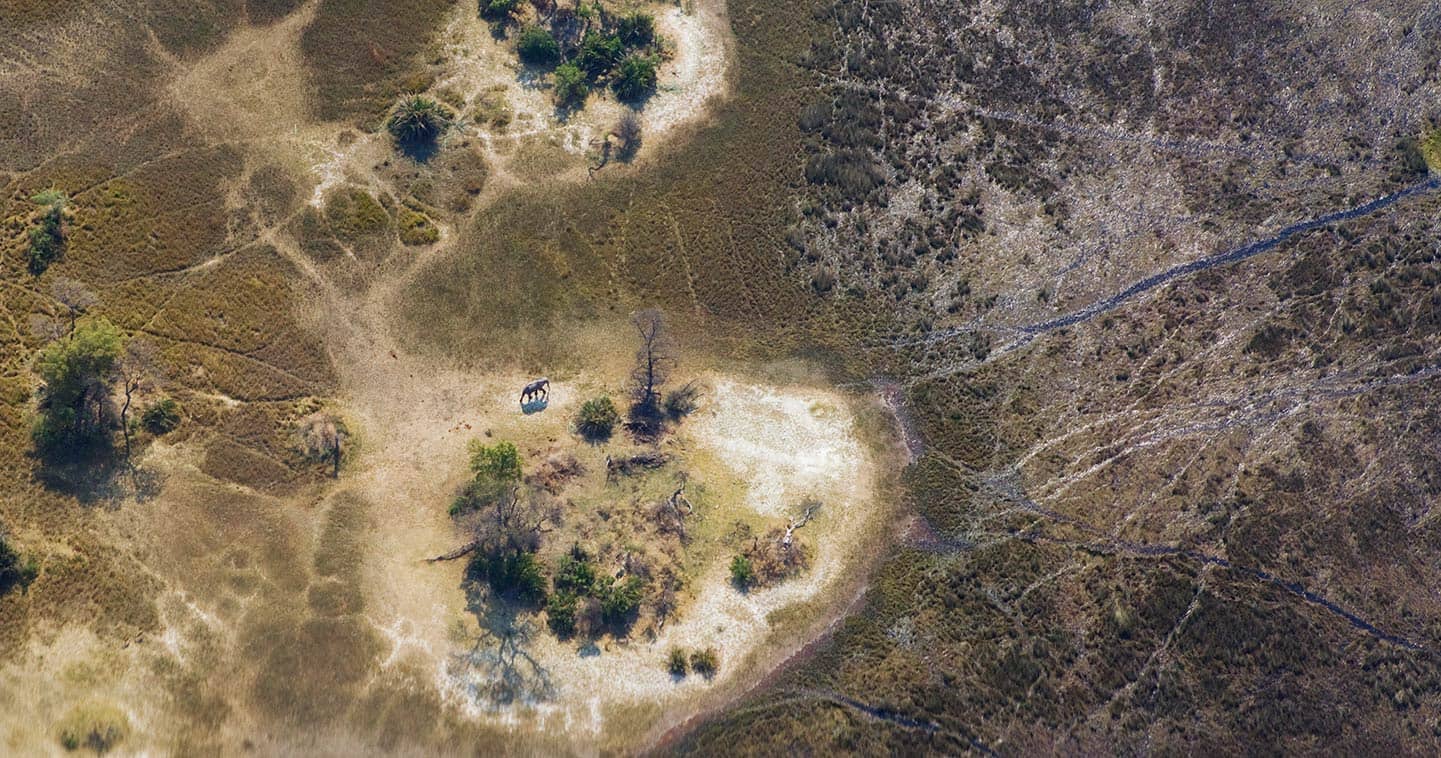
The delta occupies the northern edge of the Kalahari Basin, an immense sand-filled depression covering much of southern Africa. The Kalahari is not the barren desert its name might suggest — much of it is dry savannah and scrubland — but the Okavango’s permanent water and seasonal flooding create something entirely different: a lush, green wilderness surrounded by semi-arid landscape in every direction. Viewed from the air, the contrast is extraordinary.
How the Okavango Delta works
The Okavango is not, strictly speaking, a delta at all — it is an alluvial fan, formed where a river loses momentum and spreads across flat ground. What makes it remarkable is where that happens: not at a coastline, but in the middle of a desert. The Okavango River carries water from the Angolan highlands 1,200 km to the northwest, flowing south through Namibia before entering Botswana at the narrow, channel-like Panhandle. There, the land becomes astonishingly flat — dropping just 60 metres over a distance of 250 km — and the river dissolves into an intricate maze of channels, lagoons, floodplains and palm-fringed islands.
The defining characteristic of this system is its timing. The Angolan rains fall between November and March, but the water needs nearly four months to reach Botswana from the Angolan highlands. As a result, the delta reaches peak flood in July — deep into Botswana’s dry winter, when local rainfall has stopped entirely. This extraordinary mismatch between local rainfall and flood timing is what gives the Okavango its unique seasonal rhythm: high water when other water sources across the Kalahari have dried up, concentrating wildlife along the delta’s channels at the very moment the weather is most comfortable for visitors.
Roughly 96% of the water that flows into the delta never flows out again. It evaporates, is drawn up by plants, or soaks into the deep Kalahari sand. The Okavango is one of the few river systems anywhere on the planet whose water never reaches the sea — a terminal system that has sustained life in this landscape for tens of thousands of years. To see the flood in motion, explore our interactive Okavango Delta story or watch the water expand and contract month by month on our satellite-based flood cycle map.
Landscape and ecosystems
The diversity of habitats packed into the delta is extraordinary for a single protected area. Permanent deepwater channels wind through papyrus beds and stands of tall phragmites reed, opening into lily-covered lagoons that shimmer in the early morning light. Seasonal floodplains — bone-dry for half the year, knee-deep in clear water for the other — bridge the gap between the permanent waterways and the drier land beyond. Elevated islands, many formed over millennia by termite mounds that gradually accumulated sand and soil, support dense woodland of wild fig, sycamore fig, sausage tree, and knobthorn acacia. On the largest islands, such as Chief’s Island (the biggest landmass in the delta, formed along a tectonic fault line), open grassland and mopane woodland create the kind of savannah landscape more commonly associated with East Africa. The eastern edge of the delta is protected by the Moremi Game Reserve, which covers roughly 40% of the delta’s total area.
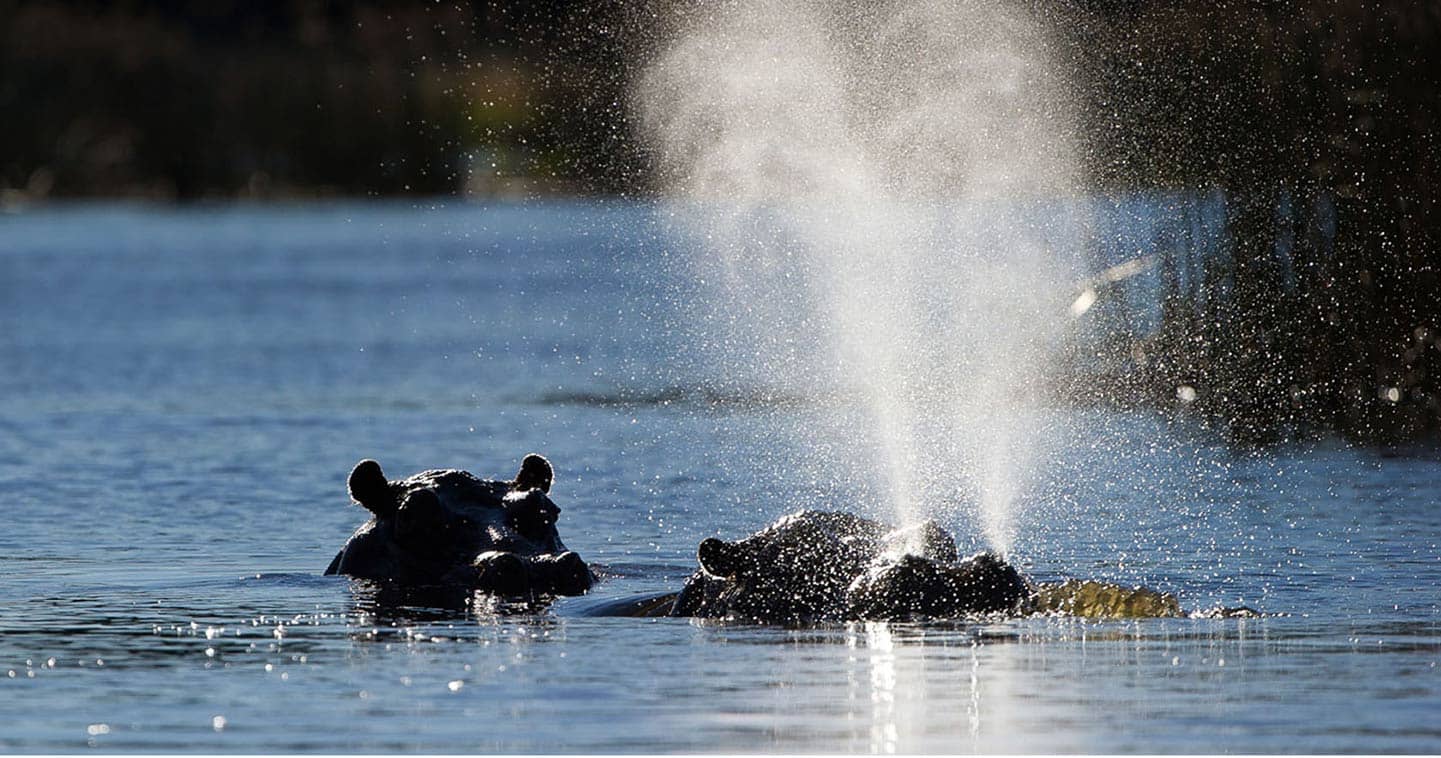
This patchwork of water and land is what gives the Okavango its ecological richness. Species that depend on permanent water — hippo, crocodile, the semi-aquatic sitatunga antelope, and the delta’s huge populations of red lechwe — coexist alongside large terrestrial mammals that move between the islands and floodplains as the water rises and falls. Few places in Africa compress so many different ecosystems into so compact an area.
Wildlife
The Okavango supports all of the Big Five — lion, leopard, elephant, buffalo, and (since the reintroduction of white rhino) rhinoceros — along with cheetah, wild dog, spotted hyena, and a range of smaller predators including African wildcat, serval, and honey badger. Elephant numbers in northern Botswana are among the highest on the continent; during the dry season, large herds move through the delta on their way between the Chobe and Linyanti systems to the northeast.
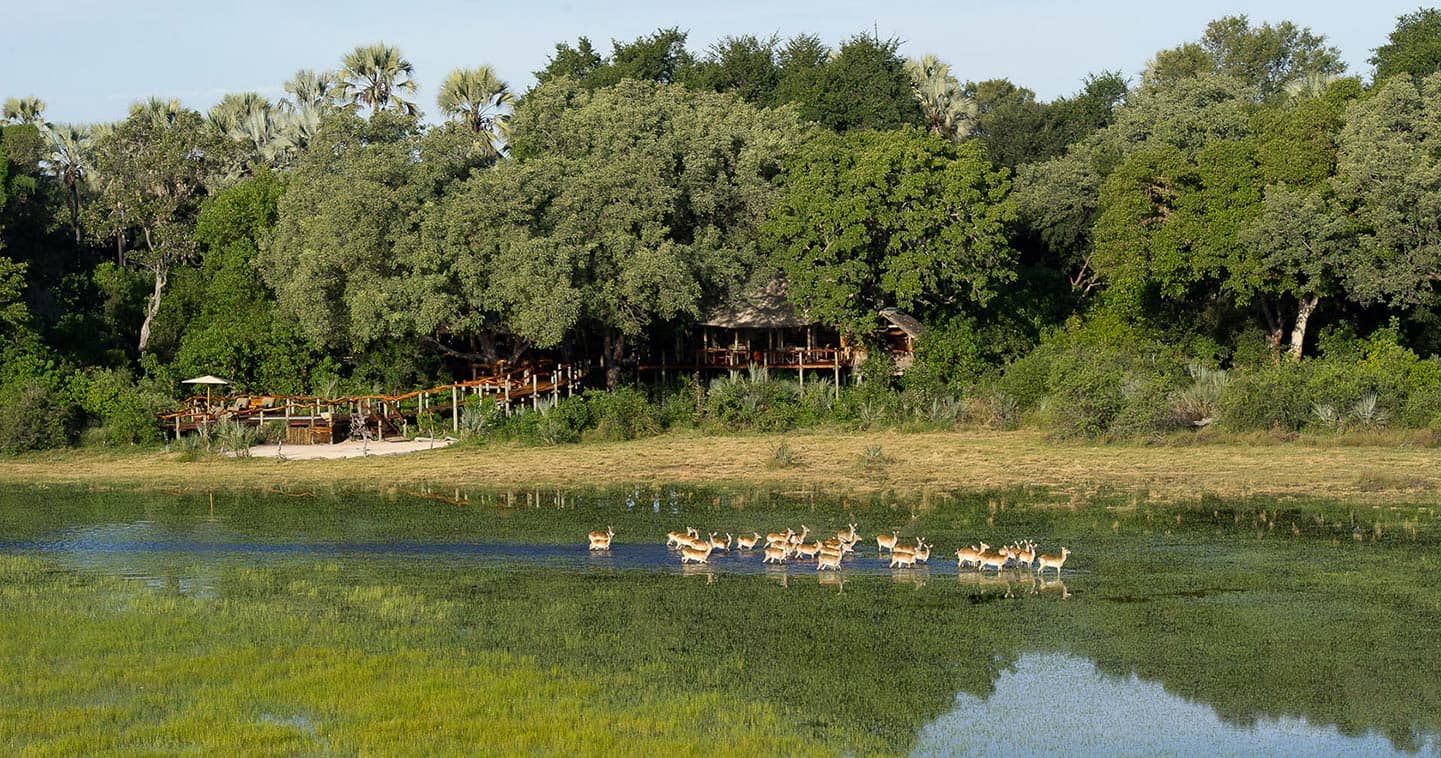
Beyond the headline species, the delta has its own cast of specialists. Red lechwe — the most abundant large antelope here, numbering in the tens of thousands — run through shallow water in great splashing herds — a spectacle found nowhere else in Africa. The shy sitatunga, adapted to life in deep marsh, can submerge almost entirely when threatened, breathing through its nostrils just above the waterline. Pel’s fishing owl, one of Africa’s rarest and most elusive raptors, hunts along the quiet channels at dusk — a sighting that dedicated birders travel thousands of miles to achieve.
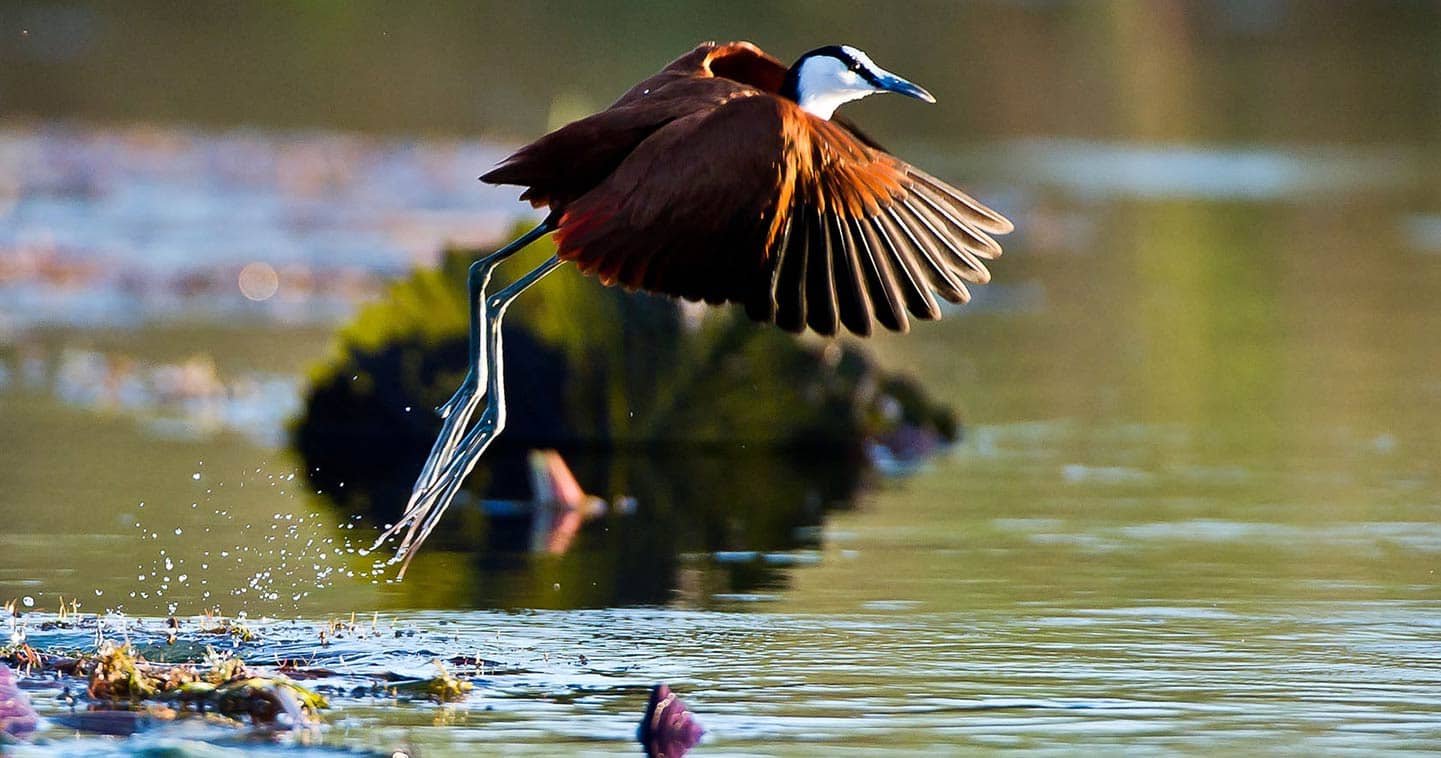
Birdlife is prolific year-round but peaks during the wet season (November to March) when over 200 migratory species join the 480-plus resident species. Breeding colonies of herons, storks and egrets gather in spectacular numbers, and species like the wattled crane, slaty egret, and African skimmer draw specialist birders from around the world. For a fuller picture of what you might see and when, visit our Okavango Delta wildlife guide.
A brief history
The earliest known inhabitants of the Okavango Delta region were the San (Bushmen), whose hunter-gatherer communities lived along the delta’s margins for thousands of years. European exploration arrived in 1849 when David Livingstone, travelling north from the Cape Colony, encountered the vast wetland and recorded his astonishment at the abundance of rivers and trees in what he had expected to be empty desert.
The decades that followed were less kind. European hunters depleted wildlife populations across northern Botswana, a pattern repeated across much of the continent during the colonial period. The turning point came in 1963, when the BaTawana people — the local Tswana community — took the extraordinary step of proclaiming the Moremi Game Reserve on their own ancestral land, making it one of the first community-initiated game reserves in Africa. The reserve was later extended to include Chief’s Island in 1976, protecting the delta’s most wildlife-rich area.
In 2014, the Okavango Delta was inscribed as a UNESCO World Heritage Site — the 1,000th site on the list — in recognition of its outstanding natural value. Today, the delta is managed through a system of private concessions that balances tourism revenue, conservation, and community benefit, a model that has become one of the most successful examples of sustainable wildlife tourism anywhere in Africa.
Safari activities
What sets the Okavango apart from other safari destinations is the range of ways you can explore it. Most reserves offer game drives; the Okavango offers game drives, mokoro excursions, motorboat safaris, walking safaris, catch-and-release fishing, and scenic helicopter flights — often from the same camp, on the same day.
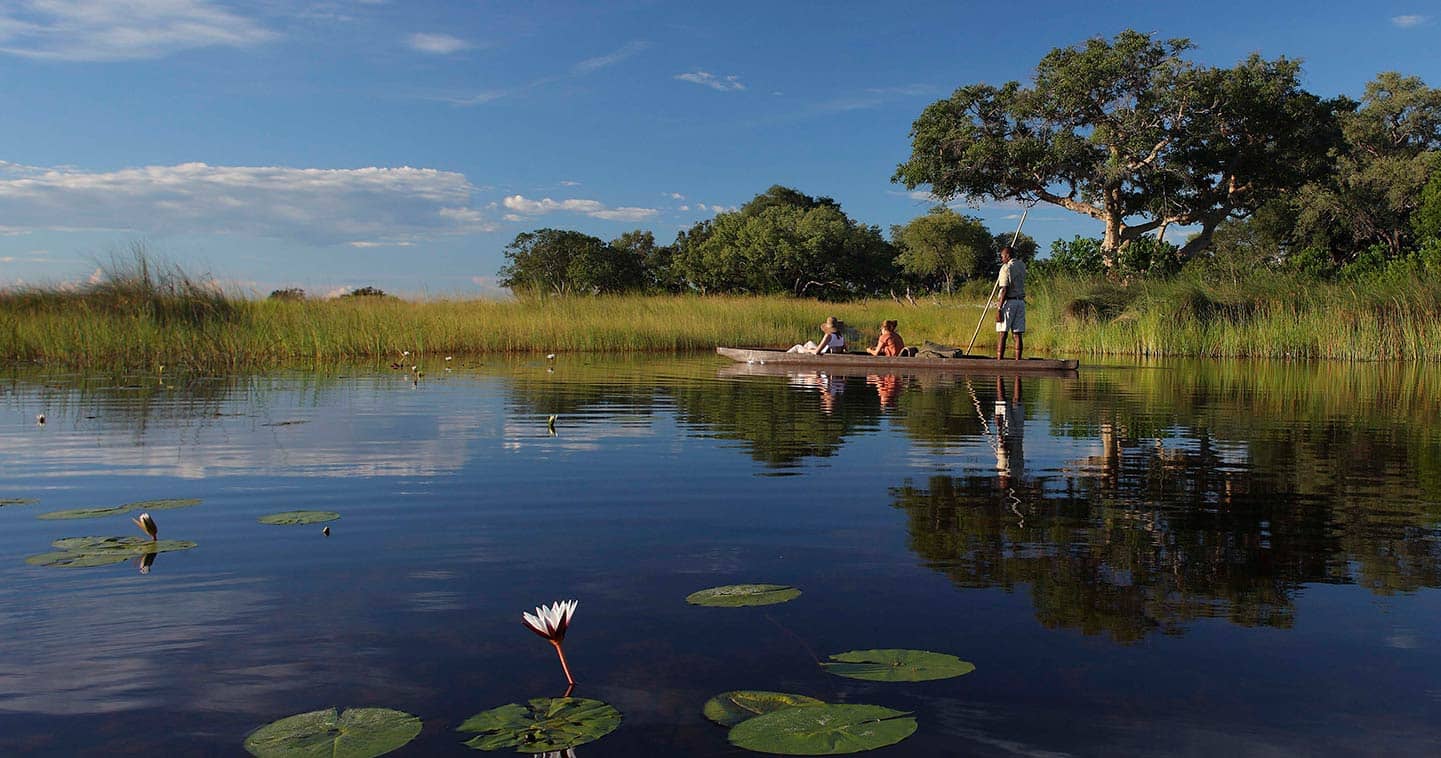
The mokoro — a traditional dugout canoe, now usually made from fibreglass to protect the region’s hardwood trees — is the signature Okavango experience. Poled silently through narrow channels by your guide, you sit at water level among the lilies, reeds and papyrus, close enough to hear painted reed frogs and watch malachite kingfishers dive. It is an entirely different way of experiencing the African bush, and one that only the Okavango’s water-based camps can offer.
Game drives on the delta’s larger islands and drier concession areas deliver the more familiar open-vehicle safari experience, with excellent predator sightings particularly during the dry season when vegetation thins and animals concentrate near water. Walking safaris — guided on foot through the bush with an armed ranger — are available in selected concessions and offer an intensity of experience that a vehicle simply cannot replicate.
Fishing enthusiasts come for the tigerfish — a powerful, acrobatic freshwater predator — and for the annual barbel run (August to October) when shoals of catfish surge through the channels, drawing herons, fish eagles, and crocodiles into a frenzied waterborne hunt.
Conservation
The Okavango Delta’s survival depends on an unbroken corridor of water connecting Angola, Namibia and Botswana — a chain that is increasingly under pressure. Proposed water extraction projects upstream, including Angolan irrigation projects and proposed hydropower development on the Namibian reach of the river, could reduce the volume reaching the delta. Climate modelling for the Okavango catchment points toward less rainfall and higher temperatures over the coming decades.
For the time being, the system remains in good health. Botswana’s concession system, under which private tourism operators lease large tracts of land from the government and local communities, has proved an effective conservation mechanism. Tourism revenue provides the economic incentive to protect the land from alternative uses — cattle farming, settlement, resource extraction — and community benefit-sharing ensures that the people who live alongside the wildlife have a stake in its survival. The reintroduction of white rhino to the delta in recent years, funded in part by tourism, is one of the more visible successes of this model.
Every visit to the Okavango contributes directly to this ecosystem — funding anti-poaching patrols, supporting community projects, and reinforcing the case that wild Botswana is worth more alive than developed.
Where to stay
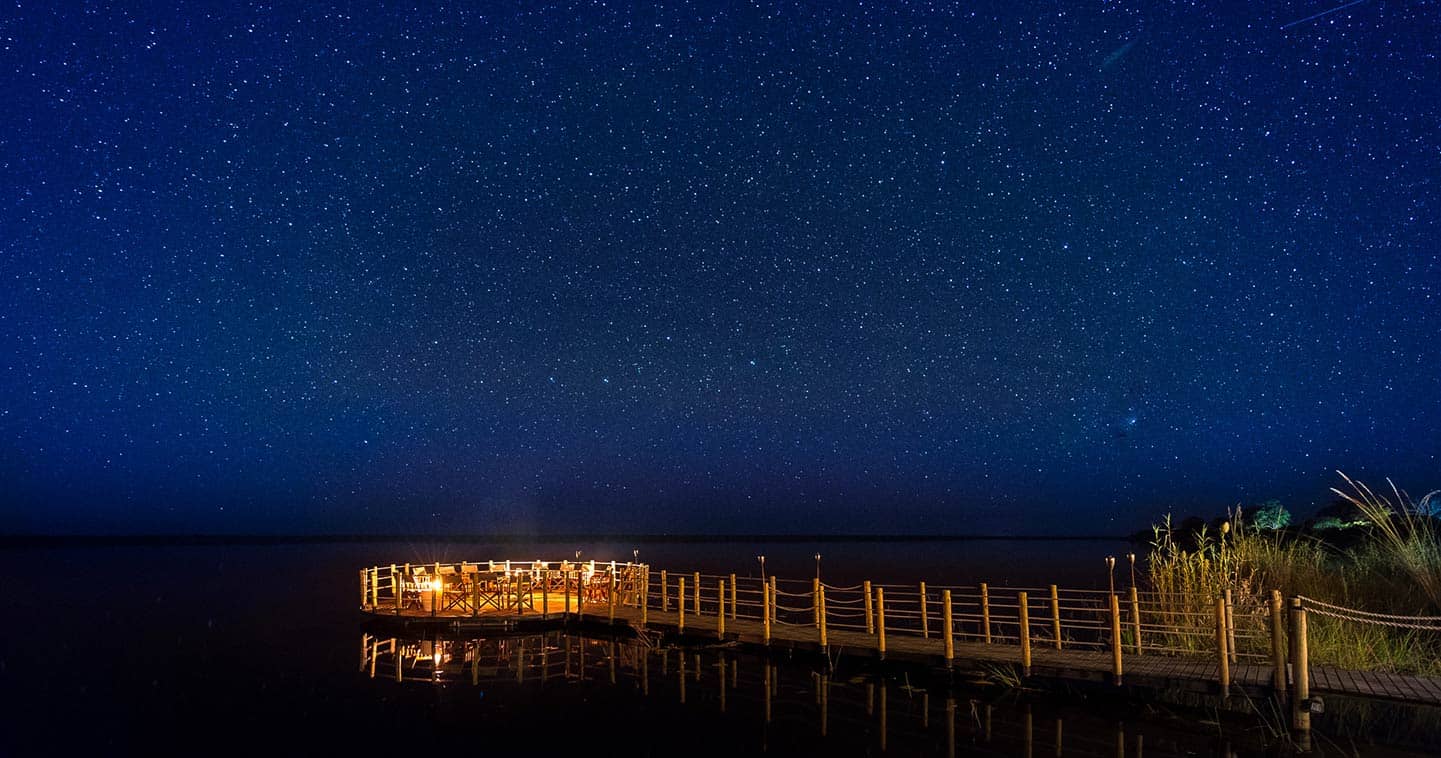
Accommodation in the Okavango Delta ranges from luxuriously appointed tented camps with private plunge pools and silver-service dining to more rustic, smaller operations where the emphasis is on guiding quality and intimacy with the bush. Almost all camps are small — typically six to twelve rooms — and most are accessible only by light aircraft, which adds to the sense of remoteness and exclusivity.
The choice between camps depends largely on what you want from your safari. Camps on permanent deepwater channels offer a water-focused experience year-round: mokoro, motorboats, and a landscape defined by papyrus, lilies, and open lagoons. Camps on larger islands or in the drier concessions to the south and east offer a more land-based experience — open-vehicle game drives, walking safaris, and big-cat sightings in classic African savannah. Many visitors combine two camps over four to six nights, splitting their time between a water and a land experience to see the full breadth of what the delta offers.
Browse our full selection of Okavango Delta lodges and camps, or get in touch for a personal recommendation based on your interests and travel dates.
Planning your visit
The Okavango Delta is a year-round destination, but the experience changes substantially with the seasons. The dry winter months (May to October) bring peak game viewing, high flood levels, and the full range of water and land activities. The wet summer months (November to March) offer extraordinary birding, lush green landscapes, and the year’s lowest rates. For a detailed breakdown of what each month delivers, see our month-by-month guide to visiting the Okavango Delta.
Most visitors fly into Maun from Johannesburg (around 1 hour 45 minutes) or Cape Town (around 2 hours 15 minutes), then transfer to their camp by light aircraft — a scenic 15- to 45-minute flight that doubles as your first game drive. Charter flights impose a strict 20 kg soft-bag limit per person — no hard cases — which shapes every packing decision. For full details on flights, transfers, and what to bring, see our getting to the Okavango Delta guide.
For peak season (May to August), we recommend booking your preferred camp nine to twelve months in advance. The most popular properties regularly fill a full year ahead. For other times of year, four to six months ahead is typically sufficient to secure a good selection of options.